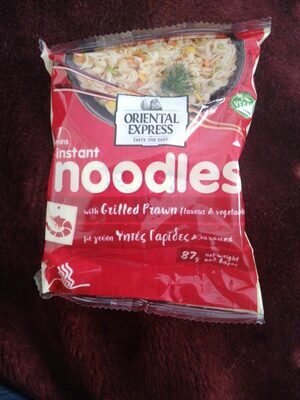
Oriental express noodles vegan prawn flavour
27
Nutrition Score
Poor

Oriental express noodles vegan prawn flavour

5206674101042
Starts at 50. Rises with whole foods, proteins, vitamins; drops with added sugars, trans fats, and syrups.
45
Hazard Score
Hazardous
5
Mirella Index
Basic
Quality category: Gourmet (80+), Everyday (50–79), or Basic (0–49)
Ingredients
wheat
wheat  ·  No known concerns
Contains cereals containing gluten
Cereal grain milled into flour for bread, pasta, and baked goods. Contains gluten.
Palm Oil
Palm-Oil  ·  −5 pts
Moderate health concern Source: WHO, EFSA
Widely used vegetable fat. High in saturated fats; linked to cardiovascular risk. Environmental concerns.
BHT (Butylated Hydroxytoluene)
E321  ·  −5 pts
Moderate health concern Source: FDA
Preservative similar to BHA. Linked to liver issues and risk of tumor promotion in high animal doses.
Citric Acid
E330  ·  No known concerns
Natural organic acid used as an antioxidant and flavoring. Safe for ingestion.
Salt (Sodium Chloride)
Salt  ·  −2 pts
Moderate health concern Source: WHO, FDA
Common table salt used for flavouring and preservation. High intake is linked to hypertension.
Triphosphates
E451  ·  −5 pts
Moderate health concern Source: EFSA
Industrial moisture-retaining agents in processed meats. Linked to vascular calcification and kidney strain when consumed regularly.
Potassium Carbonate
E501  ·  No known concerns
Alkaline salt used to regulate acidity and as a raising agent, notably in cocoa processing and noodles.
Guar Gum
E412  ·  No known concerns
Natural thickener from guar beans. Used in dairy products, sauces, and gluten-free products.
Monosodium Glutamate
E621  ·  −5 pts
Moderate health concern Source: EFSA, FDA
Flavor enhancer. Linked to headaches and sensitivity reactions in high doses.
Disodium Guanylate
E627  ·  −3 pts
Moderate health concern Source: EFSA
Flavour enhancer often used with MSG to intensify umami taste. Derived from fish or meat.
Disodium Inosinate
E631  ·  −3 pts
Moderate health concern Source: EFSA
Flavour enhancer that boosts umami. Produced from meat or fermented tapioca. Not vegetarian.
Sugar (Sucrose)
Sugar  ·  −4 pts
Moderate health concern Source: WHO, FDA
Common refined sugar. High consumption is linked to obesity, type 2 diabetes, and tooth decay.
Shallot
Shallot  ·  No known concerns
Small mild onion variety used as a savoury allium ingredient.
Maltodextrin
MaltodextrinIng  ·  −4 pts
Moderate health concern Source: FDA, EFSA
Highly processed starch derivative. Very high glycaemic index, used as filler and thickener.
Yeast Extract
YeastExt  ·  −2 pts
Moderate health concern Source: EFSA, FDA
Flavour enhancer with natural umami taste from autolysed yeast. Contains naturally occurring glutamates.
Parsley
Parsley  ·  No known concerns
Fresh herb used as a garnish and flavoring in a wide range of savory dishes.
Spices
Spices  ·  No known concerns
General term for dried plant-based seasonings such as pepper, cumin, or cinnamon, used to flavor dishes.
Glucose (Dextrose)
Glucose  ·  −3 pts
Moderate health concern Source: EFSA, FDA
Simple sugar used as a sweetener, energy source, and in food processing. High GI.
Sulphite Ammonia Caramel
E150d  ·  −5 pts
Moderate health concern Source: EFSA
Contains sulphites
Caramel colorant made using ammonia and sulphite compounds, used in colas and dark sauces. Contains sulphites allergen.
Hydrolyzed Vegetable Protein (HVP)
Hydrolyzed Vegetable Protein  ·  −4 pts
Moderate health concern Source: EFSA
Plant protein broken down by acid/enzyme hydrolysis into free amino acids (incl. glutamate); used as a savoury flavour enhancer, similar effect to MSG. Source protein (soy/wheat/corn) may be a separate declared allergen.
potato starch
potato starch  ·  No known concerns
Starch extracted from potatoes, used as a thickener and binder in sauces, baked goods, and gluten-free recipes.
Lactic Acid
E270  ·  No known concerns
Natural acid produced by fermentation. Safe preservative and acidity regulator in many foods.
Sodium Lactate
E325  ·  No known concerns
Sodium salt of lactic acid used naturally as an antioxidant and bulking agent in processed meats and doughs.
Distarch Phosphate
E1412  ·  −2 pts
Modified starch used to thicken and stabilize sauces, soups, and dairy products under heat and freezing.
Coconut Oil
CoconutOil  ·  −3 pts
Moderate health concern Source: FDA
Edible oil extracted from the kernel or meat of mature coconuts. High in saturated fat.
Onion
Onion  ·  No known concerns
Pungent bulb vegetable used raw or cooked as a base flavoring in savory dishes worldwide.
corn starch
corn starch  ·  No known concerns
Powdered starch extracted from corn kernels, used as a thickener in sauces, soups, and baked goods.
Chili / Cayenne
Chili  ·  No known concerns
Hot pepper used fresh, dried, or ground to add heat to dishes.
Silicon Dioxide
E551  ·  No known concerns
Anti-caking agent derived from silica, used in powdered foods, spices, and supplements to prevent clumping.
Cabbage
Cabbage  ·  No known concerns
Leafy cruciferous vegetable eaten raw in slaws, fermented into sauerkraut, or cooked.
Carrot
Carrot  ·  No known concerns
Crunchy orange root vegetable eaten raw or cooked, a good source of beta-carotene.
Corn (Sweetcorn)
Corn  ·  No known concerns
Sweet corn kernels eaten fresh, canned, or frozen as a vegetable.
Spring Onion
SpringOnion  ·  No known concerns
Young onion harvested before the bulb fully forms, eaten raw or lightly cooked with a mild flavor.
Advertisement
Community Reviews

Please log in to leave a review. Login

Something wrong with this product's data? v