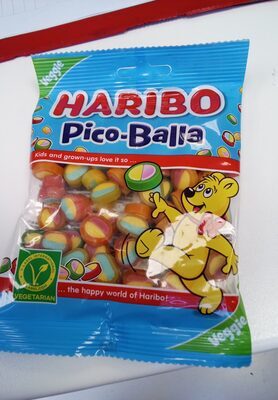
haribo picoballa
40
Nutrition Score
Poor

haribo picoballa

8426617119928
Starts at 50. Rises with whole foods, proteins, vitamins; drops with added sugars, trans fats, and syrups.
71
Hazard Score
Use with caution
47
Mirella Index
Basic
Quality category: Gourmet (80+), Everyday (50–79), or Basic (0–49)
Ingredients
Sugar (Sucrose)
Sugar  ·  −4 pts
Moderate health concern Source: WHO, FDA
Common refined sugar. High consumption is linked to obesity, type 2 diabetes, and tooth decay.
Glucose Syrup
GlucSyrup  ·  −5 pts
Moderate health concern Source: EFSA, FDA
Refined sweetener from hydrolysed starch. High glycaemic index; linked to blood sugar spikes.
wheat
wheat  ·  No known concerns
Contains cereals containing gluten
Cereal grain milled into flour for bread, pasta, and baked goods. Contains gluten.
Wheat Starch
WheatStarch  ·  No known concerns
Contains cereals containing gluten
Starch extracted from wheat, used as a thickener; may retain trace gluten.
Palm Oil
Palm-Oil  ·  −5 pts
Moderate health concern Source: WHO, EFSA
Widely used vegetable fat. High in saturated fats; linked to cardiovascular risk. Environmental concerns.
Mono- and Diglycerides of Fatty Acids
E471  ·  −3 pts
Moderate health concern Source: EFSA, FDA
Common emulsifiers derived from fats. May contain trans fats. Used in bread, margarine, and ice cream.
Citric Acid Esters of Mono- and Diglycerides
E472c  ·  −2 pts
Emulsifier used to stabilize fats and oils and prevent separation in margarine and spreads.
Glucose (Dextrose)
Glucose  ·  −3 pts
Moderate health concern Source: EFSA, FDA
Simple sugar used as a sweetener, energy source, and in food processing. High GI.
Citric Acid
E330  ·  No known concerns
Natural organic acid used as an antioxidant and flavoring. Safe for ingestion.
Carrageenan
E407  ·  −5 pts
Moderate health concern Source: EFSA
Thickener extracted from red seaweed. Some controversial evidence links degraded types to gut inflammation.
Sodium Citrate
E331  ·  No known concerns
Salt of citric acid used to control acidity and as an emulsifier in processed cheese, drinks, and desserts.
Natural Flavouring
NatFlavour  ·  No known concerns
Catch-all term for flavour compounds derived from natural sources (plants, animals, fermentation).
Spirulina
Spirulina  ·  No known concerns
Blue-green algae dried into a powder, marketed as a protein- and nutrient-dense superfood supplement.
Radish Concentrate
RadishConc  ·  No known concerns
Concentrated radish extract used to add peppery flavor or natural color to processed foods.
Blackcurrant
Blackcurrant  ·  No known concerns
Tart, dark purple berry, high in vitamin C, used in juices, jams, and liqueurs.
Apple
Apple  ·  No known concerns
Common tree fruit eaten fresh, dried, or processed into juice and sauce. A source of fiber and vitamin C.
Elderberry
Elderberry  ·  No known concerns
Dark berry used for natural coloring and flavour in juices and confectionery.
Chokeberry (Aronia)
Chokeberry  ·  No known concerns
Aronia berry, used for natural colouring/antioxidant properties.
Grape
Grape  ·  No known concerns
Whole grape fruit, distinct from grapeseed oil/tartaric acid/anthocyanins.
Curcumin
E100  ·  No known concerns
Natural yellow food coloring derived from turmeric root. Safe and beneficial.
Copper Chlorophyllins
E141  ·  −2 pts
Stabilized, water-soluble form of chlorophyll used as a natural green food colorant.
Beeswax
E901  ·  No known concerns
Natural glazing agent from bees. Used as coating on candies and fresh fruit. Safe.
Carnauba Wax
E903  ·  No known concerns
Vegan wax from palm leaves, used to coat confectionery and fruits. Safe.
Advertisement
Community Reviews

Please log in to leave a review. Login

Something wrong with this product's data? v