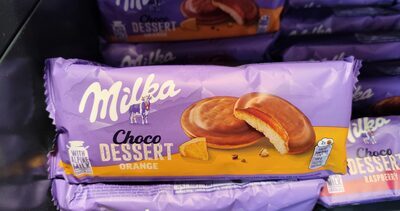
Milka Choco Dessert Orange jelly
58
Nutrition Score
Moderate

Milka Choco Dessert Orange jelly

7622300479138
Starts at 50. Rises with whole foods, proteins, vitamins; drops with added sugars, trans fats, and syrups.
73
Hazard Score
Use with caution
86
Mirella Index
Gourmet
Quality category: Gourmet (80+), Everyday (50–79), or Basic (0–49)
Ingredients
Sugar (Sucrose)
Sugar  ·  −4 pts
Moderate health concern Source: WHO, FDA
Common refined sugar. High consumption is linked to obesity, type 2 diabetes, and tooth decay.
High Fructose Corn Syrup
HFCS  ·  −5 pts
Moderate health concern Source: FDA, WHO
Refined sweetener. FDA states it is not more dangerous than other sugars; broad scientific consensus finds no meaningful metabolic difference from sucrose. Still a high-glycaemic added sugar linked to obesity/metabolic risk in excess.
wheat
wheat  ·  No known concerns
Contains cereals containing gluten
Cereal grain milled into flour for bread, pasta, and baked goods. Contains gluten.
Egg
Egg  ·  No known concerns
Contains eggs
Whole chicken egg, used as a binding, leavening, and enriching ingredient in countless recipes. Contains egg allergen.
Water
Water  ·  No known concerns
The most common ingredient in processed foods.
Cocoa Butter
CocoaButter  ·  No known concerns
Natural fat from cocoa beans. Rich in stearic acid; neutral effect on LDL cholesterol.
Milk Powder (Dried Milk)
MilkPowder  ·  No known concerns
Contains milk
Milk with the water removed, sold as a shelf-stable powder for reconstituting or baking. Contains milk allergen.
potato starch
potato starch  ·  No known concerns
Starch extracted from potatoes, used as a thickener and binder in sauces, baked goods, and gluten-free recipes.
Cocoa Mass (Liquor)
CocoaMass  ·  No known concerns
Pure ground cocoa beans. The foundational component of high-quality dark chocolate. Rich in polyphenols.
Glycerol (Glycerin)
E422  ·  No known concerns
Humectant used to maintain moisture in cakes, protein bars, and chocolates. Generally safe but can cause mild digestive issues in massive doses.
Whey Powder (Dried Whey)
WheyPowder  ·  No known concerns
Contains milk
Dried form of whey, the liquid left after cheesemaking, used to add protein and texture to processed foods. Contains milk allergen.
Canola Oil (Rapeseed)
CanolaOil  ·  −2 pts
Moderate health concern Source: FDA, EFSA
Vegetable oil derived from a variety of rapeseed. Low in saturated fat, high in monounsaturated fats.
Milk Fat (Butterfat)
MilkFat  ·  No known concerns
Contains milk
Natural fat present in milk and dairy products. Essential for traditional butter and rich textures.
Citric Acid
E330  ·  No known concerns
Natural organic acid used as an antioxidant and flavoring. Safe for ingestion.
Malic Acid
E296  ·  No known concerns
Natural acid found in apples and pears. Used as acidity regulator and flavour enhancer.
Sodium Citrate
E331  ·  No known concerns
Salt of citric acid used to control acidity and as an emulsifier in processed cheese, drinks, and desserts.
Orange
Orange  ·  No known concerns
Citrus fruit eaten fresh or juiced, well known as a source of vitamin C and natural sugars.
Pectin
E440  ·  No known concerns
Natural gelling agent from fruit peel. Used in jams, jellies, and fruit-based products. Safe.
Grapefruit
Grapefruit  ·  No known concerns
Large citrus fruit with a tart, slightly bitter flavor, eaten fresh or juiced.
Pineapple
Pineapple  ·  No known concerns
Tropical fruit with sweet-tart flesh, eaten fresh, canned, or juiced.
Lemon
Lemon  ·  No known concerns
Citrus fruit valued for its tart juice and zest, used as a flavoring, acidifier, and source of vitamin C.
Natural Flavouring
NatFlavour  ·  No known concerns
Catch-all term for flavour compounds derived from natural sources (plants, animals, fermentation).
Soy Lecithin
SoyLecithin  ·  No known concerns
Contains soybeans
Emulsifier derived from soybean oil. Widely used in chocolate and baked goods. Generally safe.
Polyglycerol Polyricinoleate (PGPR)
E476  ·  −2 pts
Moderate health concern Source: EFSA, FDA
Emulsifier in chocolate used to reduce viscosity and replace cocoa butter. Generally safe.
Mono- and Diglycerides of Fatty Acids
E471  ·  −3 pts
Moderate health concern Source: EFSA, FDA
Common emulsifiers derived from fats. May contain trans fats. Used in bread, margarine, and ice cream.
Hazelnut Paste / Praline
HazelnutPaste  ·  −5 pts
Contains tree nuts
Ground roasted hazelnuts, often with sugar — praline base.
Salt (Sodium Chloride)
Salt  ·  −2 pts
Moderate health concern Source: WHO, FDA
Common table salt used for flavouring and preservation. High intake is linked to hypertension.
Maltodextrin
MaltodextrinIng  ·  −4 pts
Moderate health concern Source: FDA, EFSA
Highly processed starch derivative. Very high glycaemic index, used as filler and thickener.
Ammonium Carbonates
E503  ·  No known concerns
Raising agent used in biscuits and cookies. Decomposes on heating to produce CO2.
Beta-Carotene
E160a  ·  No known concerns
Natural orange-yellow pigment found in carrots. Acts as a precursor to vitamin A; generally safe.
Guar Gum
E412  ·  No known concerns
Natural thickener from guar beans. Used in dairy products, sauces, and gluten-free products.
Ascorbic Acid (Vitamin C)
E300  ·  No known concerns
Natural antioxidant vitamin. Used to prevent oxidation in foods and beverages. Safe and beneficial.
Advertisement
Community Reviews

Please log in to leave a review. Login

Something wrong with this product's data? v