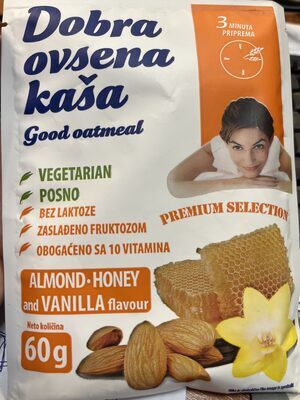
Good oatmeal
60
Nutrition Score
Moderate

Good oatmeal

0646450145566
Starts at 50. Rises with whole foods, proteins, vitamins; drops with added sugars, trans fats, and syrups.
81
Hazard Score
Healthy
65
Mirella Index
Everyday
Quality category: Gourmet (80+), Everyday (50–79), or Basic (0–49)
Ingredients
Oats
Oats  ·  No known concerns
Contains cereals containing gluten
Whole grain cereal rich in soluble fibre (beta-glucan).
Fructose
Fructose  ·  −4 pts
Moderate health concern Source: FDA
Fruit sugar metabolised in the liver. Excessive intake linked to fatty liver and metabolic syndrome.
Soy Milk
SoyMilk  ·  No known concerns
Contains soybeans
Plant-based drink produced by soaking and grinding soybeans, boiling the mixture, and filtering.
Glucose Syrup
GlucSyrup  ·  −5 pts
Moderate health concern Source: EFSA, FDA
Refined sweetener from hydrolysed starch. High glycaemic index; linked to blood sugar spikes.
sunflower oil
sunflower oil  ·  No known concerns
Vegetable oil pressed from sunflower seeds, commonly used for cooking and frying due to its light flavor.
Modified Starch
ModStarch  ·  −2 pts
Moderate health concern Source: EFSA, FDA
Chemically or physically treated starch for improved cooking properties. Generally safe.
Almond
Almond  ·  No known concerns
Contains tree nuts
Almond, a tree nut eaten whole, roasted, or ground into flour and butter; also pressed for almond milk. Contains tree nut allergen.
Maltodextrin
MaltodextrinIng  ·  −4 pts
Moderate health concern Source: FDA, EFSA
Highly processed starch derivative. Very high glycaemic index, used as filler and thickener.
Honey
Honey  ·  No known concerns
Natural sweetener made by bees from flower nectar, used in place of sugar in food and drinks.
Silicon Dioxide
E551  ·  No known concerns
Anti-caking agent derived from silica, used in powdered foods, spices, and supplements to prevent clumping.
Natural Flavouring
NatFlavour  ·  No known concerns
Catch-all term for flavour compounds derived from natural sources (plants, animals, fermentation).
Salt (Sodium Chloride)
Salt  ·  −2 pts
Moderate health concern Source: WHO, FDA
Common table salt used for flavouring and preservation. High intake is linked to hypertension.
Potassium Phosphate
E340  ·  −2 pts
Mineral salt used as an acidity regulator and emulsifier in processed cheese, meat, and baked goods.
Ascorbic Acid (Vitamin C)
E300  ·  No known concerns
Natural antioxidant vitamin. Used to prevent oxidation in foods and beverages. Safe and beneficial.
Tocopherol (Vitamin E)
E306  ·  No known concerns
Natural vitamin E extract used as an antioxidant in fats and oils. Essential nutrient.
Vitamin B6 (Pyridoxine)
VitB6  ·  No known concerns
Essential B vitamin involved in protein metabolism and brain development, added to fortify cereals and supplements.
Thiamine (Vitamin B1)
Thiamine  ·  No known concerns
Essential B vitamin that helps convert food into energy, added to fortify flour, cereals, and supplements.
Riboflavin (Vitamin B2)
E101  ·  No known concerns
Essential B vitamin that also acts as a natural yellow-orange food colorant, added to fortify cereals and dairy alternatives.
Vitamin B12 (Cyanocobalamin)
VitB12  ·  No known concerns
Essential B-vitamin for nervous system and blood cells. Fortified in plant-based foods.
Pantothenic Acid (B5)
PantAcid  ·  No known concerns
Essential B vitamin involved in energy metabolism, added to fortify cereals and supplements.
Folic Acid (Vitamin B9)
FolicAcid  ·  No known concerns
Synthetic form of vitamin B9, added to fortify flour and cereals. Important for cell growth and preventing birth defects.
Niacin (Vitamin B3)
Niacin  ·  No known concerns
Essential B vitamin involved in energy metabolism, added to fortify flour and cereals.
Biotin (Vitamin B7)
Biotin  ·  No known concerns
Water-soluble B vitamin involved in metabolism and healthy skin, hair, and nails. Added to fortified foods and supplements.
Advertisement
Community Reviews

Please log in to leave a review. Login

Something wrong with this product's data? v