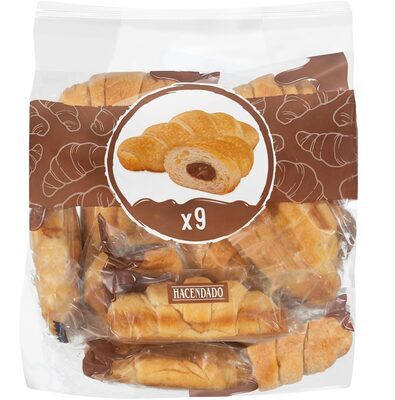
Croissant con crema de chocolate
40
Nutrition Score
Poor

Croissant con crema de chocolate

8480000829320
Starts at 50. Rises with whole foods, proteins, vitamins; drops with added sugars, trans fats, and syrups.
58
Hazard Score
Use with caution
57
Mirella Index
Everyday
Quality category: Gourmet (80+), Everyday (50–79), or Basic (0–49)
Ingredients
wheat
wheat  ·  No known concerns
Contains cereals containing gluten
Cereal grain milled into flour for bread, pasta, and baked goods. Contains gluten.
Gluten
GlutenIng  ·  −3 pts
Moderate health concern Source: EFSA, FDA
Contains cereals containing gluten
Protein complex in wheat, rye and barley. Causes coeliac disease in ~1% of population.
Hazelnut Cream Filling
HazelnutFilling  ·  −5 pts
Sweet spread or filling made from hazelnuts blended with sugar and often cocoa, used in pastries and confectionery.
Sugar (Sucrose)
Sugar  ·  −4 pts
Moderate health concern Source: WHO, FDA
Common refined sugar. High consumption is linked to obesity, type 2 diabetes, and tooth decay.
sunflower oil
sunflower oil  ·  No known concerns
Vegetable oil pressed from sunflower seeds, commonly used for cooking and frying due to its light flavor.
Cocoa Powder
CocoaPow  ·  No known concerns
Decocoated cocoa solids providing rich chocolate flavor and intense antioxidant flavonoids.
corn starch
corn starch  ·  No known concerns
Powdered starch extracted from corn kernels, used as a thickener in sauces, soups, and baked goods.
Vegetable Oil
VegOil  ·  No known concerns
General term for oil pressed from plant sources such as soybean, sunflower, or rapeseed, used for cooking and frying.
Hazelnut Paste / Praline
HazelnutPaste  ·  −5 pts
Contains tree nuts
Ground roasted hazelnuts, often with sugar — praline base.
Tree Nuts
TreeNuts  ·  −2 pts
Moderate health concern Source: EFSA, FDA
Contains tree nuts
Includes almonds, walnuts, hazelnuts, cashews, pistachios etc. Major allergen group.
Milk Powder (Dried Milk)
MilkPowder  ·  No known concerns
Contains milk
Milk with the water removed, sold as a shelf-stable powder for reconstituting or baking. Contains milk allergen.
Whey Powder (Dried Whey)
WheyPowder  ·  No known concerns
Contains milk
Dried form of whey, the liquid left after cheesemaking, used to add protein and texture to processed foods. Contains milk allergen.
Soy Lecithin
SoyLecithin  ·  No known concerns
Contains soybeans
Emulsifier derived from soybean oil. Widely used in chocolate and baked goods. Generally safe.
Natural Flavouring
NatFlavour  ·  No known concerns
Catch-all term for flavour compounds derived from natural sources (plants, animals, fermentation).
Water
Water  ·  No known concerns
The most common ingredient in processed foods.
Egg
Egg  ·  No known concerns
Contains eggs
Whole chicken egg, used as a binding, leavening, and enriching ingredient in countless recipes. Contains egg allergen.
Yeast
Yeast  ·  No known concerns
Single-celled fungus used to ferment dough for bread and beer, or as a nutritional supplement (nutritional yeast).
Lecithin
E322  ·  No known concerns
Natural emulsifier often derived from soy or eggs. Completely safe.
Mono- and Diglycerides of Fatty Acids
E471  ·  −3 pts
Moderate health concern Source: EFSA, FDA
Common emulsifiers derived from fats. May contain trans fats. Used in bread, margarine, and ice cream.
DATEM (Diacetyl Tartaric Acid Esters)
E472e  ·  −2 pts
Moderate health concern Source: EFSA
Emulsifier and dough strengthener used in bread and cakes. Generally safe at permitted levels.
Invert Sugar
InvertSugar  ·  −8 pts
Moderate health concern Source: EFSA, FDA
Hydrolysed sucrose syrup used in confectionery.
Salt (Sodium Chloride)
Salt  ·  −2 pts
Moderate health concern Source: WHO, FDA
Common table salt used for flavouring and preservation. High intake is linked to hypertension.
Wheat Fibre
WheatFibre  ·  No known concerns
Contains cereals containing gluten
Insoluble dietary fibre from wheat bran/stalks; some processed forms are gluten-free.
Citric Acid
E330  ·  No known concerns
Natural organic acid used as an antioxidant and flavoring. Safe for ingestion.
Beta-Carotene
E160a  ·  No known concerns
Natural orange-yellow pigment found in carrots. Acts as a precursor to vitamin A; generally safe.
Sorbic Acid
E200  ·  −2 pts
Moderate health concern Source: EFSA, FDA
Naturally occurring preservative used in cheeses, wines and baked goods. Generally considered safe.
Potassium Sorbate
E202  ·  −2 pts
Moderate health concern Source: EFSA, FDA
Widely used mild preservative to prevent mold. Generally recognized as safe within standard legal limits.
Calcium Propionate
E282  ·  −2 pts
Moderate health concern Source: FDA
Antifungal preservative used in sliced breads. May cause behavioral changes or migraines in sensitive children.
Carboxymethyl Cellulose
E466  ·  −2 pts
Moderate health concern Source: EFSA
Thickener and texturizer. Linked in recent studies to alterations in intestinal barriers.
Xanthan Gum
E415  ·  No known concerns
Thickener and stabilizer produced by bacterial fermentation. Safe in normal food amounts.
Advertisement
Community Reviews

Please log in to leave a review. Login

Something wrong with this product's data? v