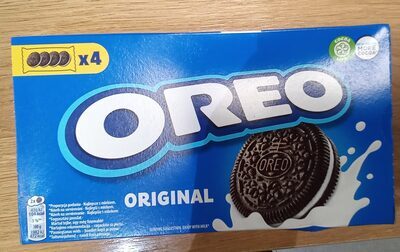
Oreo
33
Nutrition Score
Poor

Oreo

7622300444181
Starts at 50. Rises with whole foods, proteins, vitamins; drops with added sugars, trans fats, and syrups.
76
Hazard Score
Use with caution
38
Mirella Index
Basic
Quality category: Gourmet (80+), Everyday (50–79), or Basic (0–49)
Ingredients
wheat
wheat  ·  No known concerns
Contains cereals containing gluten
Cereal grain milled into flour for bread, pasta, and baked goods. Contains gluten.
Niacin (Vitamin B3)
Niacin  ·  No known concerns
Essential B vitamin involved in energy metabolism, added to fortify flour and cereals.
Elemental Iron (Reduced Iron)
ElementalIron  ·  No known concerns
Fine reduced-iron powder used to fortify cereals and baked goods. A different chemical form from ferrous sulphate or iron pyrophosphate; nutritionally serves the same iron-fortification purpose.
Thiamine (Vitamin B1)
Thiamine  ·  No known concerns
Essential B vitamin that helps convert food into energy, added to fortify flour, cereals, and supplements.
Riboflavin (Vitamin B2)
E101  ·  No known concerns
Essential B vitamin that also acts as a natural yellow-orange food colorant, added to fortify cereals and dairy alternatives.
Folic Acid (Vitamin B9)
FolicAcid  ·  No known concerns
Synthetic form of vitamin B9, added to fortify flour and cereals. Important for cell growth and preventing birth defects.
Sugar (Sucrose)
Sugar  ·  −4 pts
Moderate health concern Source: WHO, FDA
Common refined sugar. High consumption is linked to obesity, type 2 diabetes, and tooth decay.
Palm Oil
Palm-Oil  ·  −5 pts
Moderate health concern Source: WHO, EFSA
Widely used vegetable fat. High in saturated fats; linked to cardiovascular risk. Environmental concerns.
Canola Oil (Rapeseed)
CanolaOil  ·  −2 pts
Moderate health concern Source: FDA, EFSA
Vegetable oil derived from a variety of rapeseed. Low in saturated fat, high in monounsaturated fats.
Cocoa Powder
CocoaPow  ·  No known concerns
Decocoated cocoa solids providing rich chocolate flavor and intense antioxidant flavonoids.
Glucose (Dextrose)
Glucose  ·  −3 pts
Moderate health concern Source: EFSA, FDA
Simple sugar used as a sweetener, energy source, and in food processing. High GI.
High Fructose Corn Syrup
HFCS  ·  −5 pts
Moderate health concern Source: FDA, WHO
Refined sweetener. FDA states it is not more dangerous than other sugars; broad scientific consensus finds no meaningful metabolic difference from sucrose. Still a high-glycaemic added sugar linked to obesity/metabolic risk in excess.
Sodium Carbonates (Baking Soda)
E500  ·  No known concerns
Common raising agent and acidity regulator. Safe at normal food use levels.
corn starch
corn starch  ·  No known concerns
Powdered starch extracted from corn kernels, used as a thickener in sauces, soups, and baked goods.
Salt (Sodium Chloride)
Salt  ·  −2 pts
Moderate health concern Source: WHO, FDA
Common table salt used for flavouring and preservation. High intake is linked to hypertension.
Soy Lecithin
SoyLecithin  ·  No known concerns
Contains soybeans
Emulsifier derived from soybean oil. Widely used in chocolate and baked goods. Generally safe.
Chocolate
Chocolate  ·  −3 pts
Moderate health concern
Sweet food made from roasted cacao beans, combined with sugar and often milk. High in added sugar and saturated fat in most confectionery forms.
Ethyl Vanillin
EthylVanillin  ·  No known concerns
Synthetic aroma compound mimicking vanilla bean flavor. Highly concentrated flavor profile; completely safe for human ingestion.
Advertisement
Community Reviews

Please log in to leave a review. Login

Something wrong with this product's data? v