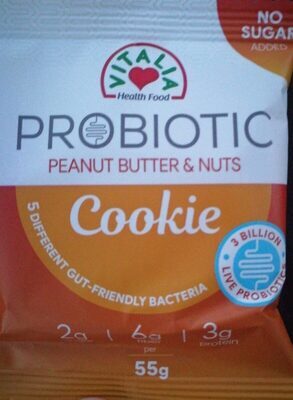
Probiotic cookies
76
Nutrition Score
Moderate

Probiotic cookies

5310099022650
Starts at 50. Rises with whole foods, proteins, vitamins; drops with added sugars, trans fats, and syrups.
82
Hazard Score
Healthy
79
Mirella Index
Everyday
Quality category: Gourmet (80+), Everyday (50–79), or Basic (0–49)
Ingredients
Oats
Oats  ·  No known concerns
Contains cereals containing gluten
Whole grain cereal rich in soluble fibre (beta-glucan).
Maltitol
E965  ·  −2 pts
Moderate health concern Source: EFSA
Sugar alcohol sweetener. Safe for teeth but causes digestive gas, bloating, and laxative effects in moderate doses.
Milk Powder (Dried Milk)
MilkPowder  ·  No known concerns
Contains milk
Milk with the water removed, sold as a shelf-stable powder for reconstituting or baking. Contains milk allergen.
Palm Oil
Palm-Oil  ·  −5 pts
Moderate health concern Source: WHO, EFSA
Widely used vegetable fat. High in saturated fats; linked to cardiovascular risk. Environmental concerns.
Cocoa Mass (Liquor)
CocoaMass  ·  No known concerns
Pure ground cocoa beans. The foundational component of high-quality dark chocolate. Rich in polyphenols.
Soy Lecithin
SoyLecithin  ·  No known concerns
Contains soybeans
Emulsifier derived from soybean oil. Widely used in chocolate and baked goods. Generally safe.
Oligofructose Syrup
OligofructoseSyrup  ·  No known concerns
Prebiotic fiber syrup derived from chicory or inulin-rich plants, used as a low-calorie sweetener and fiber booster.
Glycerol (Glycerin)
E422  ·  No known concerns
Humectant used to maintain moisture in cakes, protein bars, and chocolates. Generally safe but can cause mild digestive issues in massive doses.
Sorbitol
E420  ·  −2 pts
Moderate health concern Source: EFSA, FDA
Sugar alcohol used as a sweetener and humectant. Can have a laxative effect in large amounts.
Canola Oil (Rapeseed)
CanolaOil  ·  −2 pts
Moderate health concern Source: FDA, EFSA
Vegetable oil derived from a variety of rapeseed. Low in saturated fat, high in monounsaturated fats.
Peanut
PeanutIng  ·  −3 pts
Moderate health concern Source: EFSA, FDA
Contains peanuts
One of the most common and severe food allergens. Can cause anaphylaxis.
Vegetable Fibre
VegFibre  ·  No known concerns
General term for plant-derived fiber added to processed foods to boost fiber content and improve texture.
Tree Nuts
TreeNuts  ·  −2 pts
Moderate health concern Source: EFSA, FDA
Contains tree nuts
Includes almonds, walnuts, hazelnuts, cashews, pistachios etc. Major allergen group.
Walnut
Walnut  ·  No known concerns
Contains tree nuts
Wrinkled tree nut with a rich, slightly bitter flavor, eaten whole or used in baking. Contains tree nut allergen.
Hazelnut
Hazelnut  ·  No known concerns
Contains tree nuts
Round tree nut with a rich, sweet flavor, eaten whole, roasted, or ground into pastes like Nutella. Contains tree nut allergen.
Lactobacillus bulgaricus & Strep. thermophilus
YogurtCult  ·  No known concerns
Live active bacterial cultures responsible for traditional yogurt fermentation and gut health.
Live Probiotic Cultures
ProbioticCultures  ·  No known concerns
Live beneficial bacterial cultures added to foods.
Inulin
Inulin  ·  No known concerns
Prebiotic fiber extracted from chicory root or other plants, used to add fiber and a mild sweetness to processed foods.
Natural Flavouring
NatFlavour  ·  No known concerns
Catch-all term for flavour compounds derived from natural sources (plants, animals, fermentation).
Salt (Sodium Chloride)
Salt  ·  −2 pts
Moderate health concern Source: WHO, FDA
Common table salt used for flavouring and preservation. High intake is linked to hypertension.
Plain Caramel
E150a  ·  No known concerns
Natural brown colorant made by heating sugar, used to darken drinks, sauces, and baked goods.
Advertisement
Community Reviews

Please log in to leave a review. Login

Something wrong with this product's data? v