Free Food Barcode Scanner

Know What's Really In Your Food

Scan any food barcode to instantly reveal a 0–100 nutrition score, a full ingredient hazard breakdown, and E-number classifications — sourced from EFSA & FDA.

or enter barcode manually

EFSA & FDA sourced data
No account required
Camera stays on your device
Free forever

How FoodsScan Works

Three steps to understand what you're eating

1. Scan the Barcode

Point your camera at any food product barcode — or type it manually. No app download. Works in any modern browser.

2. Analyse Ingredients

Our database cross-references each ingredient and E-number against EFSA and FDA safety classifications and hazard levels.

3. See Your Score

Get a clear 0–100 nutrition score, a colour-coded verdict, and a full ingredient-by-ingredient breakdown with risk explanations.

How the Score Works

A transparent, science-backed scoring method

Every product is rated on nutritional quality and ingredient safety. Each ingredient adjusts the score based on its nutritional value and its hazard level as classified by regulatory agencies. The clearer and cleaner the ingredient list, the higher the score.

80 – 100
Healthy
Minimal hazardous additives detected
50 – 79
Use with caution
Some ingredients warrant attention
0 – 49
Hazardous
Multiple high-risk ingredients present

Why FoodsScan?

Privacy First

Your camera feed never leaves your device. We use no advertising trackers and collect no personal data without consent.

Regulatory Sources

Ingredient classifications are based on peer-reviewed data from EFSA (European Food Safety Authority) and the U.S. FDA.

Community Powered

Missing products can be submitted by the community. Photograph the label and we read the ingredients from it, then a moderator checks the result.

Instant & Offline

Install FoodsScan as a PWA on any device. Works offline for previously scanned products. No app store required.

Frequently Asked Questions

What is FoodsScan?

FoodsScan is a free food barcode scanner that analyses the ingredients in any packaged food product and returns a 0–100 nutrition score. It classifies each ingredient by hazard level using data from the European Food Safety Authority (EFSA) and the U.S. Food and Drug Administration (FDA). No account or app download is required.

How is the score calculated?

Each product is scored on nutritional value and ingredient safety. Every ingredient adjusts the score according to its nutritional contribution and its hazard level (low, medium, or high). Scores range from 0 to 100: 80–100 is healthy, 50–79 warrants caution, and 0–49 is classified as hazardous.

What are E-numbers and are they dangerous?

E-numbers are codes assigned by the EU to approved food additives including preservatives, colorants, emulsifiers, and flavour enhancers. Not all E-numbers are dangerous — many are derived from natural sources. However, some (such as E621 monosodium glutamate or E951 aspartame) carry medium or high hazard classifications from certain regulatory bodies. FoodsScan shows the specific classification and regulatory source for each E-number.

Is FoodsScan free?

Yes. FoodsScan is completely free. You can scan barcodes, view scores, and read all ingredient information without creating an account. An optional free account lets you post community reviews and submit missing products.

Does FoodsScan track me?

No. Your camera feed is processed entirely on your device using the browser's native BarcodeDetector API — it is never streamed to our servers. We do not use advertising trackers, cookies for profiling, or third-party analytics for tracking. An account is optional and only required to post reviews or submit products.

What if a product is not in the database?

If a product is not found, you can contribute it. Simply photograph the product front and its ingredients label. The product appears right away, marked "not yet analysed" — we never show a score we have not actually worked out. We then read the ingredients from your label photo, match them against our database, and a moderator reviews the result before the product gets its scores.

Scan a Food Product

Point your camera at a product barcode

31
Nutrition Score
Poor

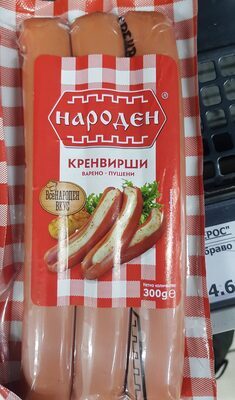
Кренвирши Народен 2995

3800047762995
Starts at 50. Rises with whole foods, proteins, vitamins; drops with added sugars, trans fats, and syrups.
44
Hazard Score
Hazardous
10
Mirella Index
Basic
Quality category: Gourmet (80+), Everyday (50–79), or Basic (0–49)
Ingredients
Pork Meat
PorkMeat  ·  No known concerns
Whole animal protein. Base component of traditional minced meat and sausages.
Water
Water  ·  No known concerns
The most common ingredient in processed foods.
Mechanically Separated Meat
MechSepMeat  ·  −8 pts
Moderate health concern
Lower-quality meat paste recovered from bones by mechanical pressure; more connective tissue/fat than whole cuts.
Pigskin (Pork Rind)
Pigskin  ·  −5 pts
Fatty processed pork by-product.
Salt (Sodium Chloride)
Salt  ·  −2 pts
Moderate health concern Source: WHO, FDA
Common table salt used for flavouring and preservation. High intake is linked to hypertension.
Diphosphates (Sodium/Potassium)
E450  ·  −5 pts
Moderate health concern Source: EFSA
Water-binding stabilizers heavily used in industrial minced meat and sausages to artificially add weight. High intake may impair calcium absorption.
Polyphosphates
E452  ·  −5 pts
Moderate health concern Source: EFSA
Water-binding phosphate in processed meat/cheese.
Pork Protein Isolate
PorkProteinIso  ·  No known concerns
A protein extract from pork used as a binder/filler in processed meat products.
potato starch
potato starch  ·  No known concerns
Vegetable Fibre
VegFibre  ·  No known concerns
Whey Powder (Dried Whey)
WheyPowder  ·  No known concerns
Contains milk
Lactose
Lactose  ·  −1 pts
Moderate health concern Source: EFSA, FDA
Contains milk
Milk sugar. Causes digestive issues in people with lactose intolerance.
Spices
Spices  ·  No known concerns
Celery
Celery  ·  No known concerns
Contains celery
Vegetable and spice. A major allergen.
Monosodium Glutamate
E621  ·  −5 pts
Moderate health concern Source: EFSA, FDA
Flavor enhancer. Linked to headaches and sensitivity reactions in high doses.
Semolina
Semolina  ·  No known concerns
Contains cereals containing gluten
Coarse wheat middlings; contains gluten.
Sodium Alginate
E401  ·  No known concerns
Seaweed-derived gelling and thickening agent. Common in molecular gastronomy and dairy products.
Guar Gum
E412  ·  No known concerns
Natural thickener from guar beans. Used in dairy products, sauces, and gluten-free products.
Xanthan Gum
E415  ·  No known concerns
Thickener and stabilizer produced by bacterial fermentation. Safe in normal food amounts.
Transglutaminase
Transglutaminase  ·  −3 pts
Enzyme used to bind pieces of meat/fish together ("meat glue").
Natural Flavouring
NatFlavour  ·  No known concerns
Catch-all term for flavour compounds derived from natural sources (plants, animals, fermentation).
Sodium Erythorbate
E316  ·  −2 pts
Antioxidant common in cured meats.
Carmine (Cochineal extract)
E120  ·  −5 pts
Moderate health concern Source: EFSA
Natural red food coloring derived from crushed insects. Used in strawberry yogurts, sweets, and meats. Known allergen; can trigger asthma or anaphylaxis.
Sodium Nitrite
E250  ·  −15 pts
High health concern Source: IARC
Preservative in cured meats. Its nitrosamine by-products are a key mechanism behind IARC classifying processed meat consumption as Group 1 carcinogenic to humans.
Community Reviews

Please log in to leave a review. Login

Something wrong with this product's data? v

Help Us Add This Product

This barcode is not in our database.

Barcode:

Tap to take or upload photo
Tap to photograph the ingredients label