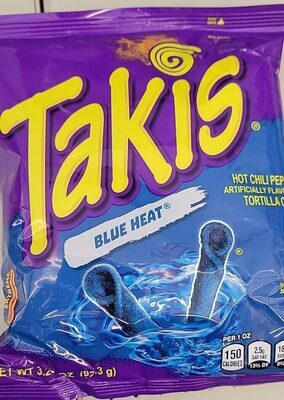
Blue Heat
24
Nutrition Score
Poor

Blue Heat

0757528048112
Starts at 50. Rises with whole foods, proteins, vitamins; drops with added sugars, trans fats, and syrups.
54
Hazard Score
Use with caution
0
Mirella Index
Basic
Quality category: Gourmet (80+), Everyday (50–79), or Basic (0–49)
Ingredients
Corn Flour
Cornflour  ·  No known concerns
Finely ground flour milled from whole corn kernels, used in breads, tortillas, and batters.
Palm Oil
Palm-Oil  ·  −5 pts
Moderate health concern Source: WHO, EFSA
Widely used vegetable fat. High in saturated fats; linked to cardiovascular risk. Environmental concerns.
Soybean Oil
SoybeanOil  ·  No known concerns
Contains soybeans
Vegetable oil pressed from soybeans, widely used for cooking and in processed foods. Contains soy allergen.
Canola Oil (Rapeseed)
CanolaOil  ·  −2 pts
Moderate health concern Source: FDA, EFSA
Vegetable oil derived from a variety of rapeseed. Low in saturated fat, high in monounsaturated fats.
Maltodextrin
MaltodextrinIng  ·  −4 pts
Moderate health concern Source: FDA, EFSA
Highly processed starch derivative. Very high glycaemic index, used as filler and thickener.
Citric Acid
E330  ·  No known concerns
Natural organic acid used as an antioxidant and flavoring. Safe for ingestion.
Sugar (Sucrose)
Sugar  ·  −4 pts
Moderate health concern Source: WHO, FDA
Common refined sugar. High consumption is linked to obesity, type 2 diabetes, and tooth decay.
Potassium Chloride
E508  ·  No known concerns
Metal halide salt used as a salt substitute and flavor enhancer. Can have a metallic taste.
Salt (Sodium Chloride)
Salt  ·  −2 pts
Moderate health concern Source: WHO, FDA
Common table salt used for flavouring and preservation. High intake is linked to hypertension.
Monosodium Glutamate
E621  ·  −5 pts
Moderate health concern Source: EFSA, FDA
Flavor enhancer. Linked to headaches and sensitivity reactions in high doses.
Hydrolyzed Vegetable Protein (HVP)
Hydrolyzed Vegetable Protein  ·  −4 pts
Moderate health concern Source: EFSA
Plant protein broken down by acid/enzyme hydrolysis into free amino acids (incl. glutamate); used as a savoury flavour enhancer, similar effect to MSG. Source protein (soy/wheat/corn) may be a separate declared allergen.
Natural Flavouring
NatFlavour  ·  No known concerns
Catch-all term for flavour compounds derived from natural sources (plants, animals, fermentation).
Artificial Flavouring
ArtFlavour  ·  −2 pts
Moderate health concern Source: FDA, EFSA
Synthetic compounds mimicking natural flavours. Safety varies; some are well studied, others less so.
Yeast Extract
YeastExt  ·  −2 pts
Moderate health concern Source: EFSA, FDA
Flavour enhancer with natural umami taste from autolysed yeast. Contains naturally occurring glutamates.
Onion Powder
OnionPowder  ·  No known concerns
Dehydrated, ground onion used as a convenient seasoning in spice blends and processed foods.
Brilliant Blue FCF
E133  ·  −5 pts
Moderate health concern Source: EFSA
Synthetic blue dye. Monitored for allergic reactions and localized cell toxicity potential.
Sodium Carbonates (Baking Soda)
E500  ·  No known concerns
Common raising agent and acidity regulator. Safe at normal food use levels.
Chili / Cayenne
Chili  ·  No known concerns
Hot pepper used fresh, dried, or ground to add heat to dishes.
Disodium Inosinate
E631  ·  −3 pts
Moderate health concern Source: EFSA
Flavour enhancer that boosts umami. Produced from meat or fermented tapioca. Not vegetarian.
Disodium Guanylate
E627  ·  −3 pts
Moderate health concern Source: EFSA
Flavour enhancer often used with MSG to intensify umami taste. Derived from fish or meat.
TBHQ
E319  ·  −5 pts
Moderate health concern Source: EFSA, FDA
Synthetic antioxidant in fried/snack foods.
Community Reviews

Please log in to leave a review. Login

Something wrong with this product's data? v